It’s time to unplug and take solace outdoors, my friends. Here are a few ways to explore the natural world in NYC and beyond this weekend (July 30-31, 2016).
Go Outside
If you’re feeling overwhelmed, take a moment of reflection at the Lily Pool Terrace at the Brooklyn Botanic Garden. It’s a good place to see water lilies and lotus flowers in bloom. As Zen teacher Thich Nhat Hahn said, “No mud, no lotus.”
Join the Torrey Botanical Society and the Natural Areas Conservancy on Saturday for a free botanical walk through the wilds of Marine Park. Learn more about one of NYC’s only maritime forests and probably see egrets and herons too.
Head to the Bronx now to see the famous Corpse Flower (amorphophallus titanum) in bloom. New York’s first corpse flower since 1939, it started to bloom last night at the New York Botanical Garden. Its bloom, which smells like rotting flesh, lasts about 24 to 36 hours.
“Though Banning would identify 23 new species and complete one of the first guides to the mushrooms of the New World, almost no one in her day knew of her discoveries, or about the striking illustrations she produced in her self-financed home laboratory.”
From my own reading shelf: I just finished Heather Wolf’s Birding at the Bridge: In Search of Every Bird at the Brooklyn Waterfront and absolutely loved it.
Heather Wolf’s delightful Birding at the Bridge: In Search of Every Bird at the Brooklyn Waterfront (at Amazon or Public Library ) begins with a quest. In order to hone her urban bird-watching skills, she set thegoal of spotting 100 bird species in the Brooklyn Bridge Park. How many birds would visit the limited habitat of a new city park? No one knew the answer and Heather was determined to find out.
A Charming How-To for Beginning City Birders
Often bird field guides look dry and daunting for someone who is just starting out. Birding at the Bridge is different — it makes bird-watching approachable, fun, and even exciting.
Heather began watching birds in NYC in 2012, after bird-watching for a couple of years in Florida. On her first birding adventure, she didn’t know she needed binoculars. For all you complete beginner birders out there, Heather started out just like you.
“To me, (birding is) exhilarating, challenging, saddening, maddening, and addictive. There’s potential for adventure at every moment, as interesting birds exhibiting entertaining behavior can show up nearly anywhere.”
She vividly describes the thrill of identifying her first bird and the rush of adrenaline with the discovery of each new bird sighting. Her enthusiasm is contagious.
Mapping Patterns in a New Urban Landscape
Brooklyn Bridge Park is a new park along the East River waterfront. Its first section, Pier One, opened in 2010. For birds, as well as urban birders, this is new terrain.
Heather’s quest to see 100 bird species in Brooklyn Bridge Park was a challenge. She would need to spend hours outside, in all types of weather, to spot new species in such a small urban park. But her daily perseverance paid off. She began to see the patterns of bird visits and behavior for each location and season.
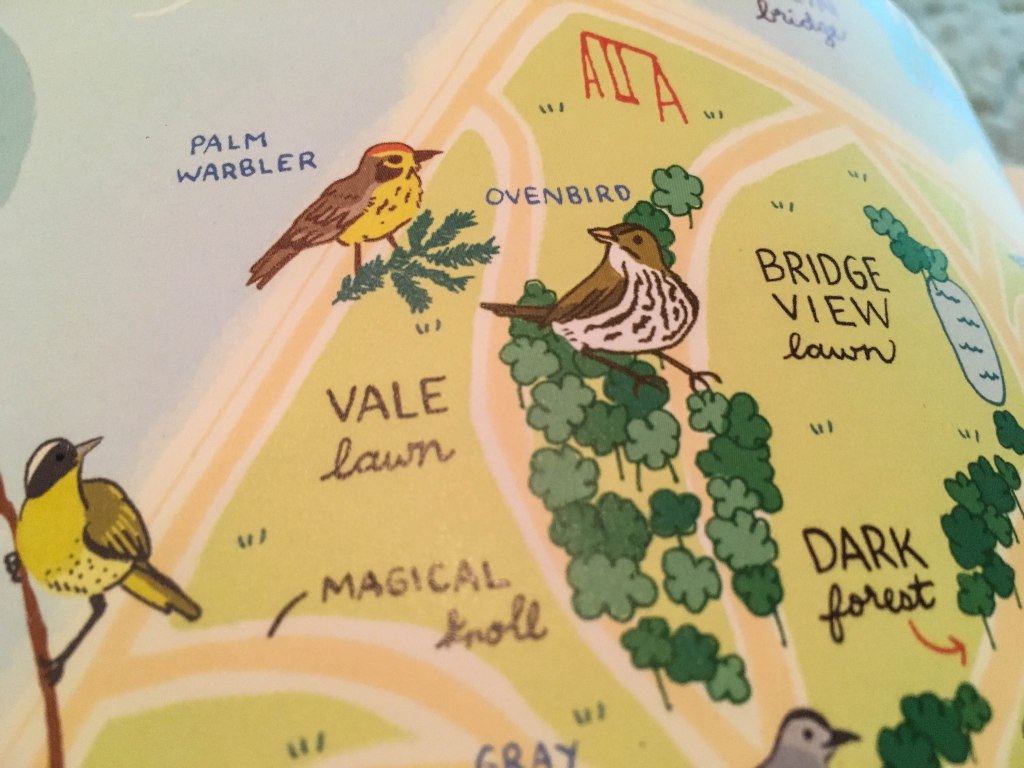
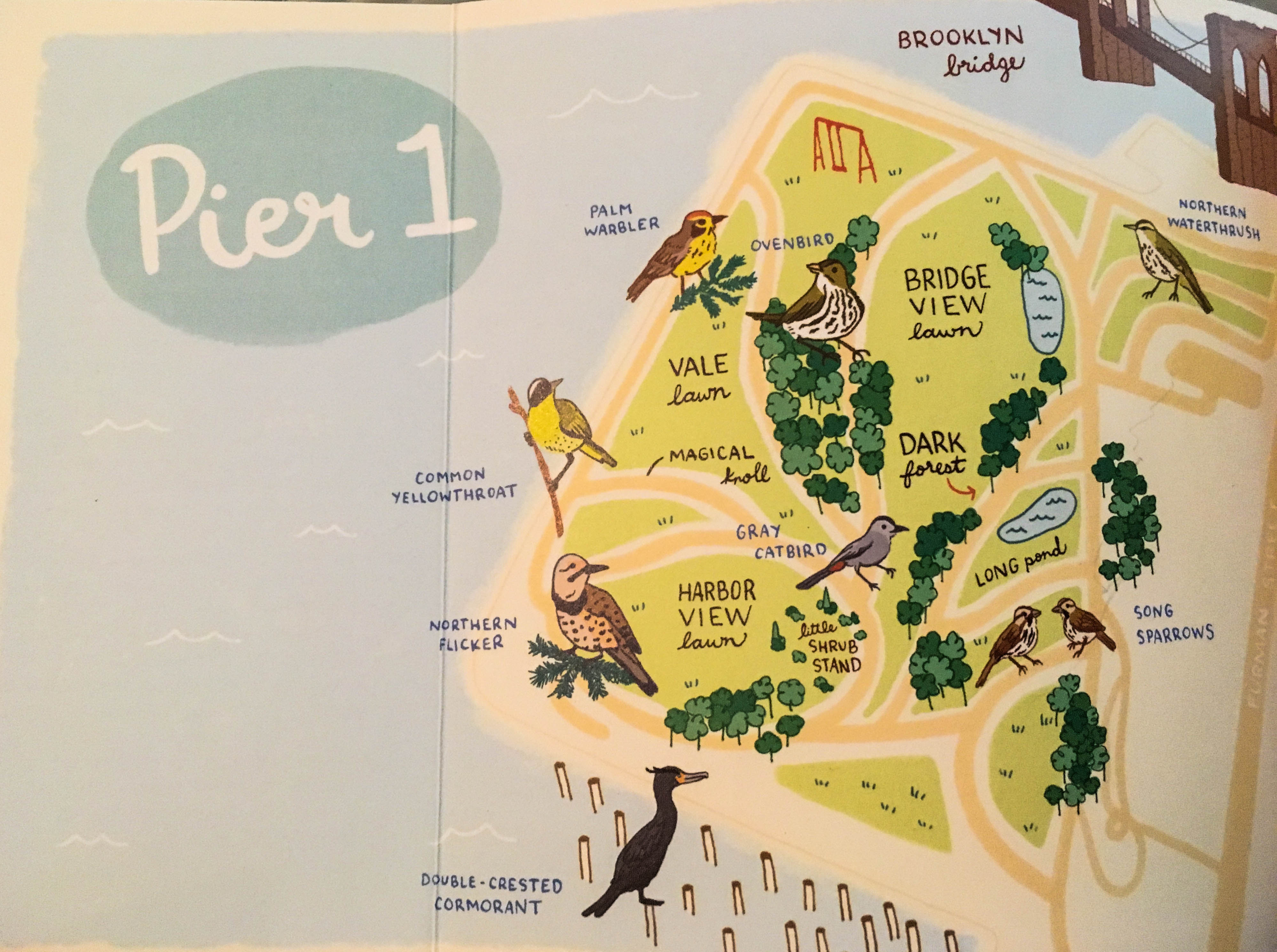
To help keep track of her bird sightings, Heather invented her own evocative names like Magical Knoll and Dark Forest for the micro-areas in the park. For anyone visiting Brooklyn Bridge Park, her mapped hotspots are extremely helpful.
A 100-Bird Quest Can Make You An Expert
As Heather continued to seek more birds, she expanded her expertise. She catalogued her daily sightings on eBird, a bird checklist application whose data is used by scientists. Longing to share her knowledge with others in-person, Heather organized a group on meetup.com and began to lead bird walks in Brooklyn Bridge Park. (Full disclosure: I’ve met Heather and have attended her wonderful bird walks.)
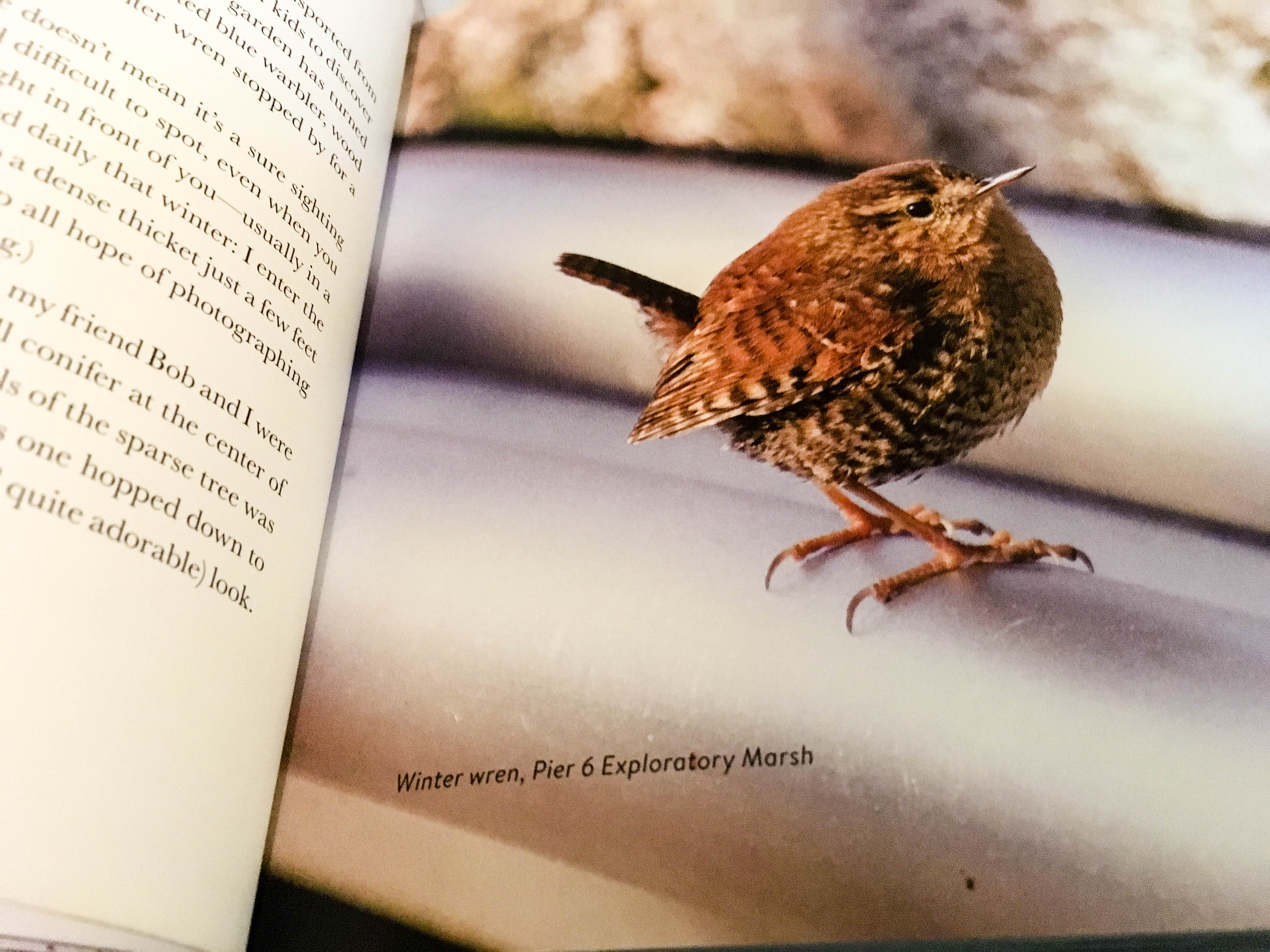
To throughly document rare sightings, Heather would need photographic proof. Though initially hesitant, she invested in a serious camera lens and learned how to use it. She then launched the site brooklynbridgebirds.com. When you see her stunning photographs, it’s difficult to believe that she wasn’t a wildlife photographer before she began her quest.
A Smart and Friendly Field Guide to the Birds of Brooklyn Bridge
Birding at the Bridge: In Search of Every Bird at the Brooklyn Waterfront will help you discover birds in one of NYC’s most beautiful parks. It’s a portable, handsome guide featuring remarkable photographs and informative descriptions of common and rare birds. The book is organized by season — this is especially helpful as many of the birds you may see in Brooklyn Bridge Park are migrants.
Birding at the Bridge is more than just a field guide. It’s also an instructive example that we can all take to heart: one’s curiosity about nature in the city can change you. Heather’s (successful!) quest to see 100 birds transformed her from a beginner to an expert. She looked deeply at a small green space; the more she looked, the more she saw. Birding at the Bridge is the delightful and generous result.
“Birding was the ultimate urban escape, but most people had no idea that something like a gorgeous scarlet tanager was hiding in the bush they just passed. I had to let them know.”
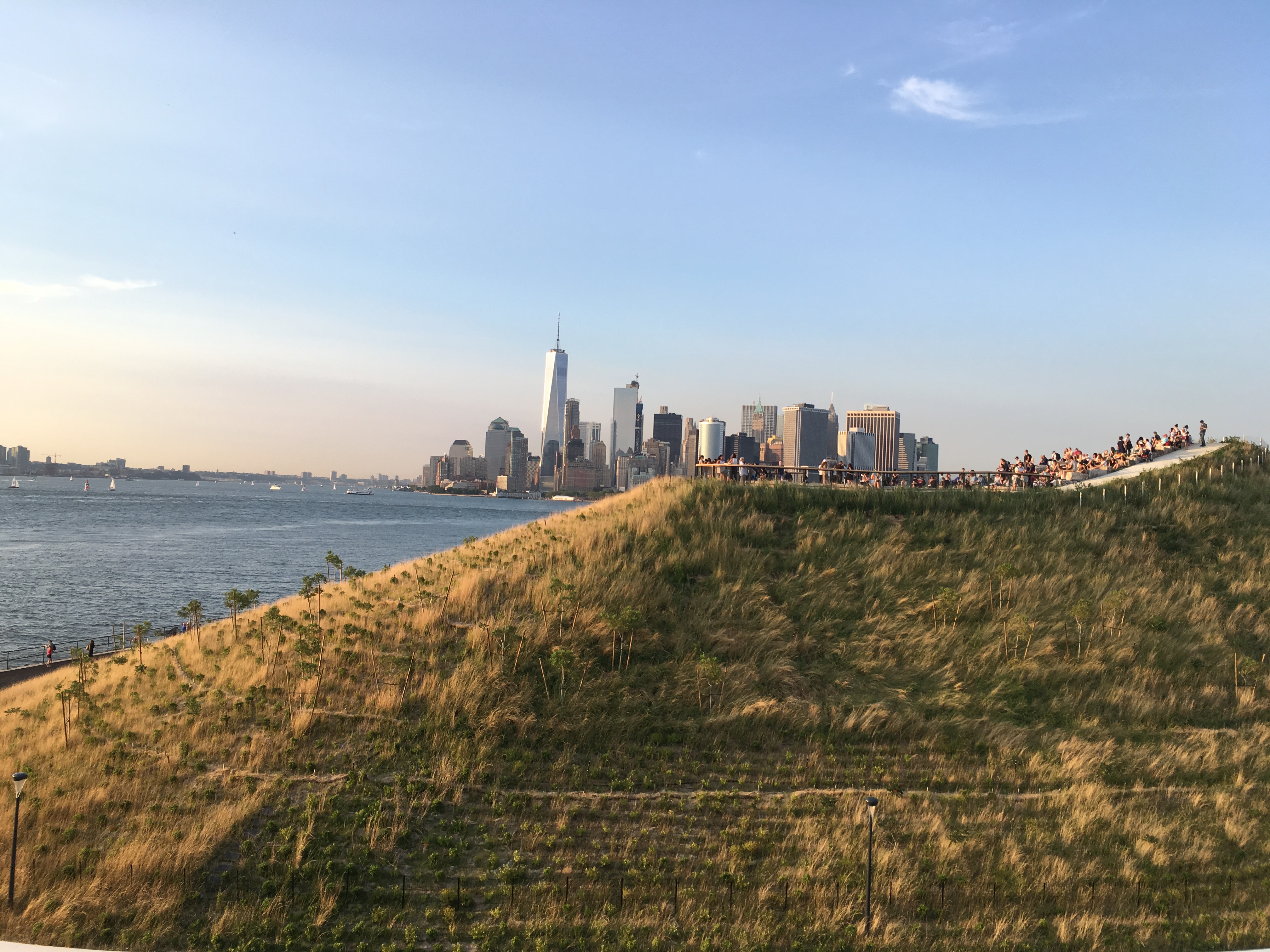
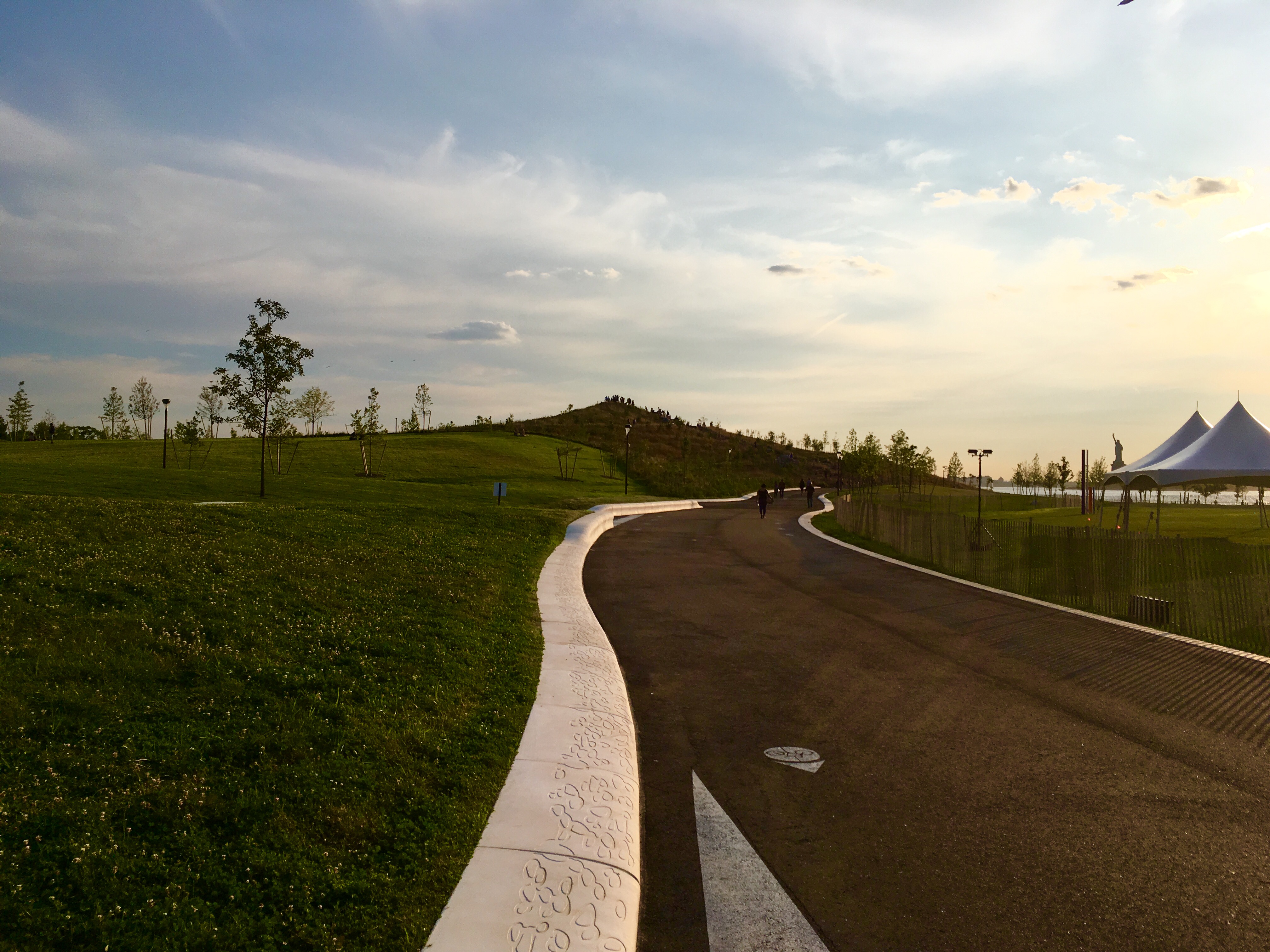
You climb a grass-covered hill and look out onto a busy harbor. The skyscrapers of Lower Manhattan rise in the distance. The iconic Statue of Liberty beckons. This is New York City’s newest and most inspiring panoramic view — the Hills of Governors Island.
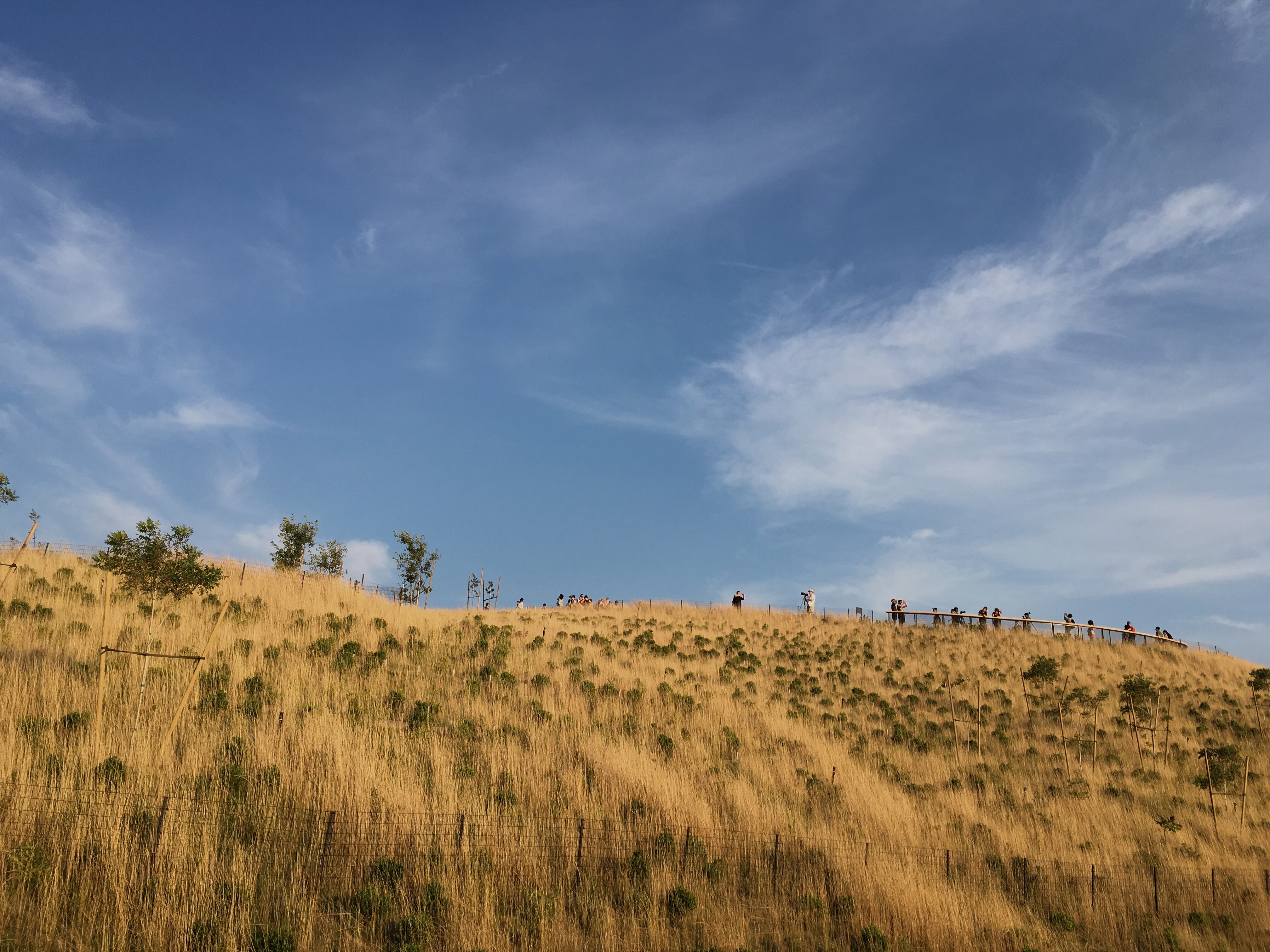
A view of Outlook Hill
The Hills is a newly opened ten-acre park on Governors Island. Eight years in the making, the new public green space features something truly unique in the five boroughs: four man-made hills with spectacular views.
Governors Island is less than half a mile from the tip of Lower Manhattan and a quarter mile from Brooklyn. It is accessible by ferry in the summer. There are no year-round residents or cars on this little island, so your visit may be a surprising bucolic (though slightly surreal) experience.
Tour the Brand New Topography in NYC’s Bay
The Hills section is in the newly opened southern area of the 172-acre islet. This part of the island was added in 1911 from the dirt excavated for the Lexington Avenue subway.
First, you will encounter Grassy Hill. It rises 25 feet and offers gentle slopes and views of the new park.
Outlook Hill in the distance
Then you will see the seventy-foot-tall Outlook Hill. This is the highest point on Governors Island.
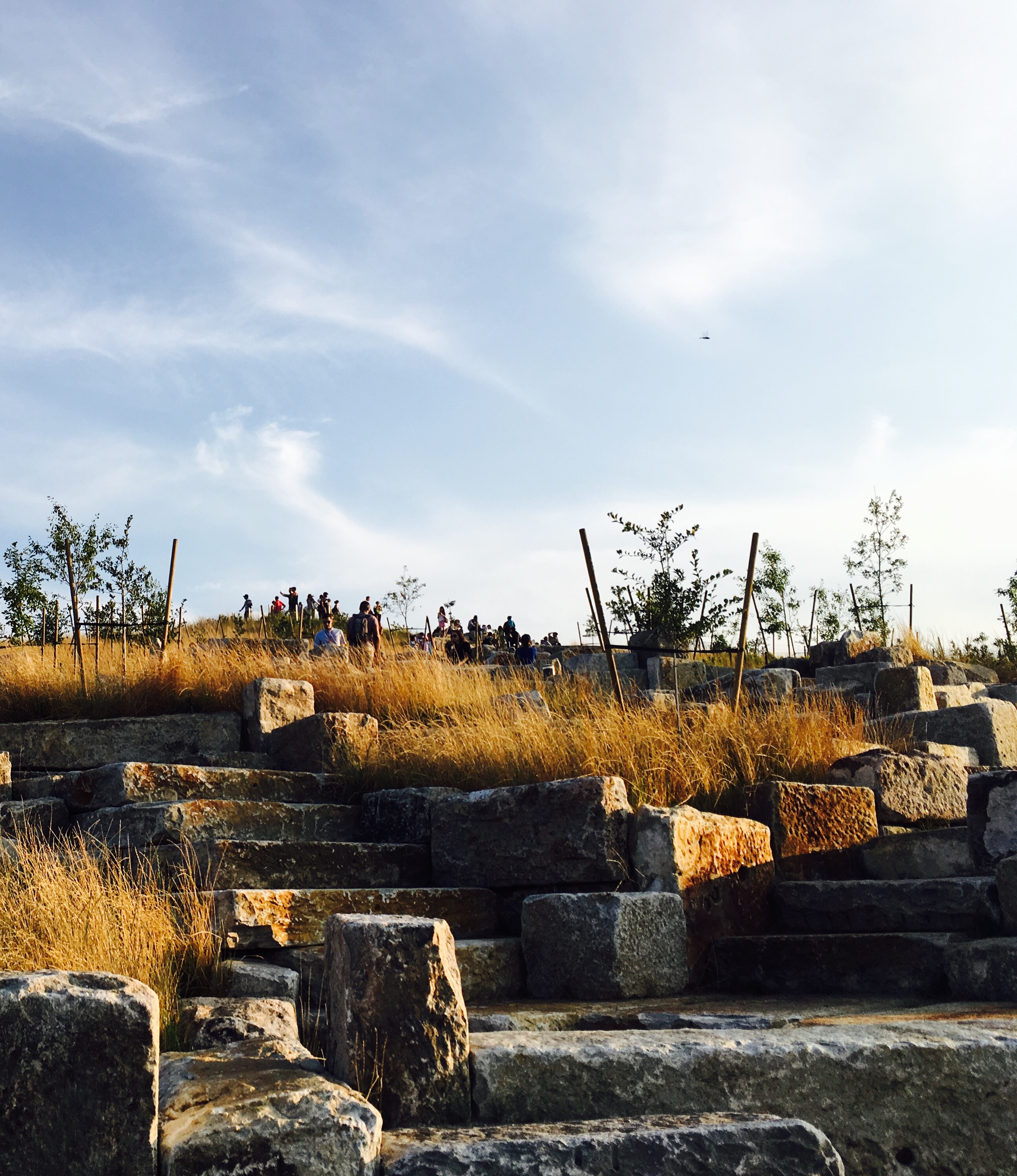
If you want an adventurous ascent, climb the enormous granite blocks of the Stone Scramble. These gigantic rocks were salvaged from the island’s former seawall.
The Stone Scramble of Outlook Hill
The Hills were made partially of recycled debris from the demolition of the buildings and parking lots on the Island. The rest of the Hills’ fill material arrived by barge from a quarry in Dutchess County.
The grasses of Outlook Hill
More than eight hundred trees in different stages of maturity — including birch, hickory, pine, sassafras, tulip poplar, and eight varieties of oak — surround the Hills. Thousands of shrubs like blueberry, sumac, and summersweet create a naturalistic landscape.
On our visit, the grasses were active with dragonflies, butterflies, and sparrows.
The Statue of Liberty beckons
Discovery Hill is a forty-foot hill of grasses, shrubs, and beautiful site-specific art.
Climbing Discovery Hill
Pause at the top of Discovery Hill. Lady Liberty is ahead of you, Brooklyn is behind you. Common terns, cormorants, and gulls may fly by. There is no traffic noise except the sound of helicopters and boats. This is a good place to listen for a non-human voice.
View from the top of Discovery HillA good place to contemplate the idea of nature and the city.
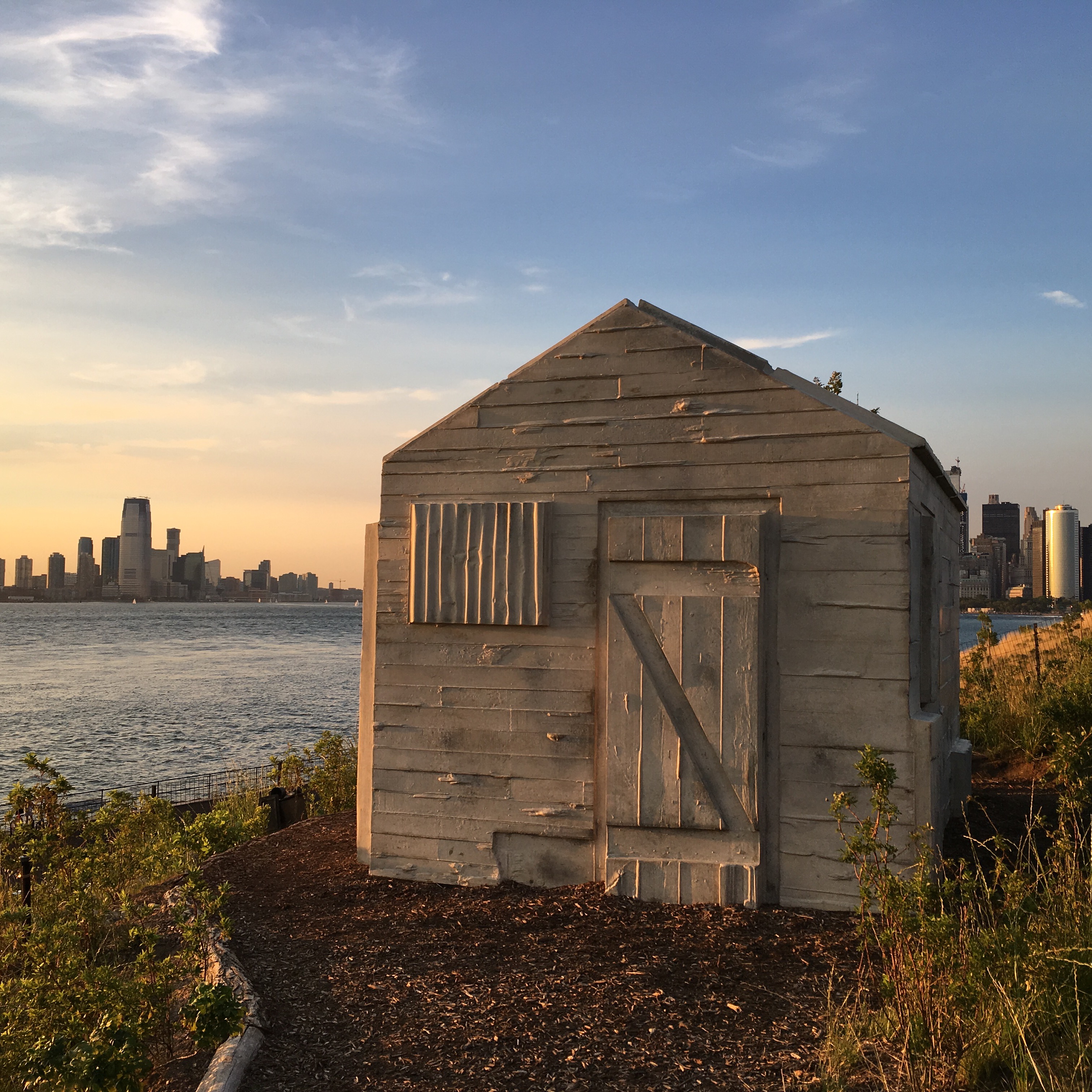
Cabin, a concrete reverse cast sculpture by Rachel Whiteread, surprises as you descend the summit of Discovery Hill.
Rachel Whiteread’s Cabin
If you have a cabin fixation like I do, this art piece may inspire fantasies.
A view from the southern tip of Governors Island
As you wind your way out, you will pass Slide Hill and its four stainless-steel chutes of different lengths, including the longest slide in NYC.
From Military Space to Public Space (and No Luxury Condos Yet)
For almost 200 years of its history, Governors Island was a military site. The City of New York bought the island from the federal government and then opened it to the public for the first time in 2003.
If you are a New Yorker or just visiting the city, it’s hard not to think about real estate while on Governors Island: How much is all of this worth? How can the City allow everyday people to enjoy it without charging an admission fee? When are the luxury condos coming?
Fortunately, restrictions imposed under the federal handover forbid several uses for the island, including gambling, permanent housing, and cars, save for service vehicles. (Hotels are permitted, though none has yet been planned.) And thanks to the water that surrounds it, the enclave will likely be spared opportunistic encroachments of the sort that now impinge on the High Line. – Martin Filler, The New York Review of Books
It’s a miracle, like Central Park is a miracle. Go and see it.
To learn more about Governors Island, the Hills, and how to get there, check out the Governors Island site.
It’s supposed to be hot this weekend in the city, a perfect excuse to spend time at the seaside. Here are a few more ways to explore the natural world in NYC and beyond (July 23 –24 , 2016):
I made a surprising discovery a few months ago. There are seahorses in the Hudson River.
I repeat: There are seahorses in the Hudson River.
Lined Seahorse at the River Project’s Wetlab
Beautiful, Strange, But Not Mythical
I learned this eye-opening fact while visiting the River Project’s Wetlab on Pier 40. The River Project is a marine science field station working to conserve habitats and wildlife in New York Harbor and the Hudson estuary.
Since 1988, the River Project has surveyed and monitored the waters off the piers of Hudson River Park. They discovered 50 fish species beneath the murky, brackish currents of the Hudson River, including the astonishing Lined Seahorse.
Seahorses have captured the human imagination for thousands of years. With its horse-shaped head, little snout, and curling tail, a seahorse looks like a demure dragon or a tiny sea monster or an adorable mythical beast. Even its genus name, Hippocampus, isancient Greek for “horse or sea monster.” This fish just looks magical or imaginary.
The River Project’s Seahorse Fact Sheet begins with this fact:
Seahorses are NOT unicorns.
The first thing to know about seahorses is that they are real.
The Seahorses of NYC
The Lined Seahorse (Hippocampus erectus), also known as the Northern Seahorse, is found in the brackish waters of New York Harbor and the Hudson River estuary. The seahorse adult is 3 to 6 inches long. Its color varies, though most seahorses in our murky waters are brown or gray. It may have lighter lines on its neck and tiny light spots on its tail.
The lined seahorse usually swims in a vertical position. It is a weak swimmer. It uses its long, prehensile tail to swim upright and to anchor itself to plant life at the bottom of the river.
The seahorse’s neck, body and tail are covered with rings of bony plates which help to protect it against predators. Its eyes can move independently of one another, so it can continually scan its surroundings.
The lined seahorse uses camouflage tactics like anchoring to a plant, staying still, and blending into the surroundings before ambushing its prey. It feeds on small crustaceans, fish eggs, and larvae by sucking them into its snout.
Nature’s Rarity: Male Pregnancy
The next time you are walking along the High Line or crossing the Brooklyn Bridge in the summertime, look out to the water and think, “Some male seahorse might be giving birth right now.”
As marine biologist Helen Scales describes in her wonderful book Poseidon’s Steed: The Story of Seahorses, from Myth to Reality, “The strangest thing about seahorses is that male seahorses are the only males in the world who have experienced — firsthand — the agonies of childbirth.”
A seahorse female places eggs in the male’s brood pouch. Only male seahorses, as Scales describes, “become truly pregnant, nurturing their young inside their bodies, providing them with food and oxygen whisking away waste products. This is all the more remarkable when we consider that pregnancy is a rare occurrence in fish, even among females.”
After three weeks gestation, the male goes into labor that can last from a few minutes to a few days. He gives birth to hundreds of flea-sized miniature seahorses. Then the female returns and the male may be pregnant again the very next day.
George Arents Collection, The New York Public Library. “Sea-horse (Hippocampus).” The New York Public Library Digital Collections.
Sea animals, engravings. Seahorse. found at vintageprintable.com
Seahorse Spotting
In the summertime, seahorses live in eelgrass, grass beds, and in the shallow waters around piers and beneath bridges. They’ve been spotted underneath the Brooklyn Bridge, near the shore of Staten Island, and all the way north to the Tappen Zee Bridge. They move to deeper waters in winter.
There aren’t any definitive numbers of seahorse populations in NY Harbor and the Hudson River. Their presence indicates the water quality and health of our waterways. But they are listed as vulnerable since 1996. Not only have they lost their habitat to pollution and coastal development, lined seahorses are also a popular for the aquarium trade and Chinese medicine.
I’d say the best way to spot a lined seahorse is to visit the River Project. What do you think? Have you seen a seahorse near NYC?
If you are in NYC over the next few days (July 16 – 20, 2016), it’s the perfect time tovisit Governors Island.
Celebrate the Terns
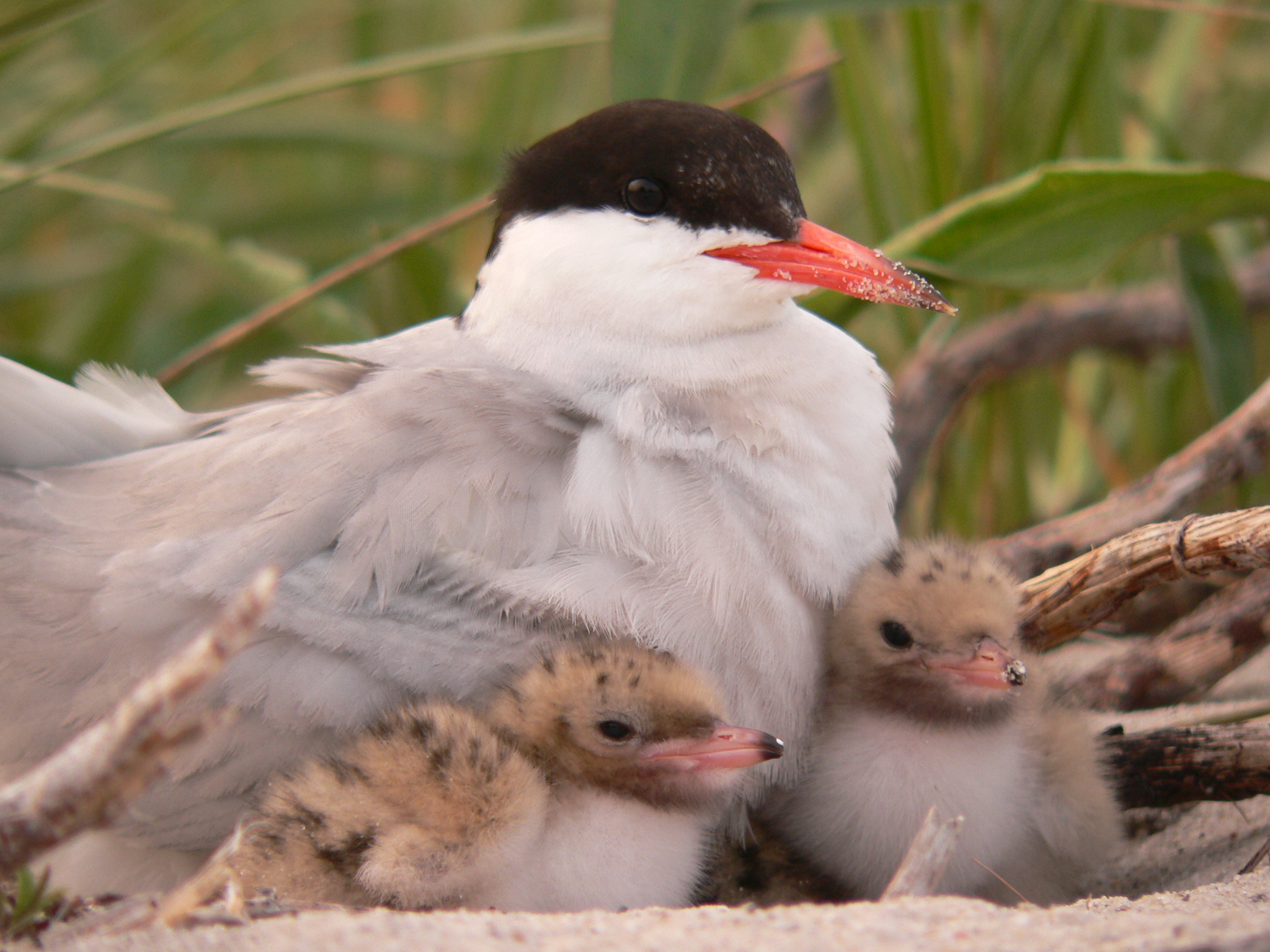
Saturday July 16 is the Tern Festival on Governors Island. Hundreds of Common Terns have recently colonized several decommissioned piers on the Governors Island waterfront. Learn more about these fascinating waterbirds from 10am to 4pm with speakers, a bird tour of Governors Island, a botany and natural history tour, family activities, and a Common Tern viewing station on Yankee pier.
Saturday, July 16 is also the City of Water Day on Governors Island. Sponsored by the Waterfront Alliance, this annual celebration of the New York Harbor is the biggest harbor festival in our region. The free boat tours are already sold out, but you can still watch the Cardboard Kayak race and learn more about our waterways.
While you’re there, get to know the importance of oysters in our harbor and estuaries with the Billion Oyster Project.
The Newest NYC Landscape Unveiled: The Hills of Governors Island
On Wednesday, July 19, the new 10-acre area called The Hills will be open to the public for the first time. Ten years in the making, The Hills features four rolling peaks, each with incredible views of the Statue of Liberty across the harbor. The New York Review of Books wrote a great piece about the history and significance of this extraordinary new landscape.
This past weekend I joined a group of fellow New Yorkers and wandered through Central Park’s North Woods. Our expedition, led by artists Ben Kinsley and Christopher Kennedy, was called Myco-Ramblings. We were in search of mushrooms.
Before we entered the forest to find fungi, Christopher suggested that our group slowly trace the horizon with our eyes. I’ve adapted Christopher’s exercise here. I think it is an ingenious way to prepare to see the small, the subtle, and the overlooked.
Warm Up Your Eyes
For your next nature walk, start at an open vista where you can easily see the horizon. Begin by standing quietly for a moment.
The Turtle Pond in Central Park is a great place to trace the horizon. (Photo by GiGi NYC)
Slowly begin to trace with your eyes where the land meets the sky:
Imagine that your eyes are a pencil; you are drawing a detailed illustration of the horizon
Starting from the left, glide slowly over each tree branch, rock outcropping, and building silhouette
Slowly trace the horizon 180 degrees to the right
Pause and then slowly re-trace the horizon as your eyes move to the left
Take your time; resist the impulse to skim over details
End where you began
Take a deep breath. You are ready to start your walk.
Now Search for the Small
Now that your eyes are warmed up, take a slow walk through a wooded area. Look for the tiny signs of nature that you might not have noticed before.
Search for mushrooms, lichen, tree sap, and acorns.
Do you see signs of life at the base of tree trunks? Along the bark of the trees? In the fallen leaves?
Notice the variation in plants along the pathway. Are there flowers? Berries?
Keep an eye out for ants, beetles, spiders, and other insects. Are there cobwebs? Small holes or burrows for insects or mammals?
If you feel adventurous, turn over logs to see what is underneath.
If you notice something on your “small walk” that piques your curiosity, take notes or pictures. It’s ok if you can’t identify what you see now. You may learn to identify it later.
Places in NYC to Find Small Signs of Nature
If you can find a wooded path in the five boroughs, you’ve found your perfect place to look for small signs of the natural world. Some of my favorite forest paths are:
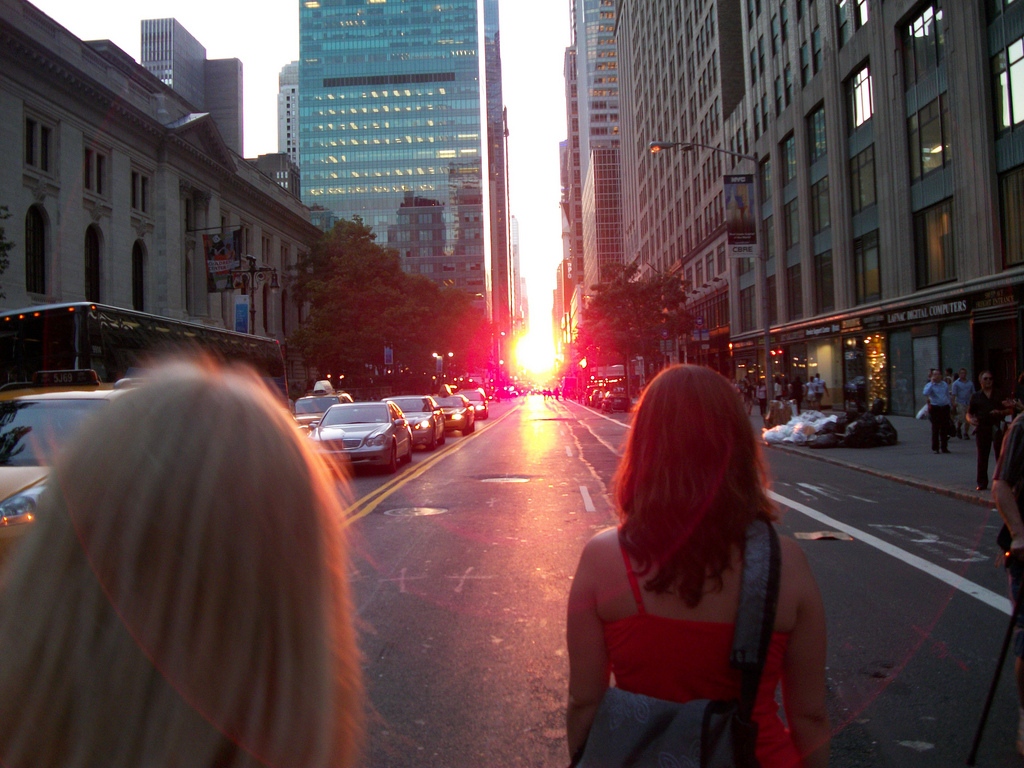
Monday, July 11 will have a “full sun,” as the full solar disk sets just above the horizon. Tuesday, July 12 will have a “half sun” as the solar disk is partially hidden below the horizon. The sun sets at 8:20pm on both days.
Last night at a party I got into a discussion with a friend about nature in New York City. I told my friend how I was writing the beginner’s guide Slow Nature Fast City. He smiled a wry smile and said, “Honestly, I’m skeptical about nature in NYC.”
My friend is a native New Yorker. I’ve lived in the city just shy of two decades but didn’t grow up there. Like many native New Yorkers, my friend is forthright and pragmatic — traits I find endearing. He made three points during our conversation:
There isn’t nature in NYC
NYC nature is man-made and doesn’t “count”
Nature isn’t for people like us
Do you know the moment of exhilaration when you hear someone say exactly what you’ve been thinking of? That’s how I felt last night. I’ve thought about these three ideas for years.
There Isn’t Nature in New York City
My friend grew up in lower Manhattan in the 1980s and 1990s. The parks and waterfronts were dangerous places to visit. I understand why he doesn’t believe that there are more than a few pigeons, rats, and scraggly street trees in his hometown.
But New York City today is different. Yes, there is still crime, but the city parks and greenways are more inviting. The variety of ecosystems is startling. NYC is a city sprawled across an archipelago, bordered by estuaries and the ocean. Tides surround us, whether we recognize their existence or not.
NYC is also a vast urban forest of over 5 million trees. Meadows, waterfalls, gardens, tide pools, forests, beaches and salt marshes are within walking distance or a subway ride away. Nature is here in the concrete jungle. I discovered that you just have to pay attention to see it.
City Nature Is Man-Made and Doesn’t Count
My friend made the point that New York is one of the most man-made environments on the planet. Every inch of the boroughs has been modified by humans over the city’s 400-year history. My friend said that when we look at “nature” in NYC, from the landscape design of Central Park to the exotic cultivars of the trees in the Bronx, we must recognize that none of it is in its “natural” state.
I know that my local favorite Prospect Park is a designed landscape. (The fire hydrants along the wooded paths are stark reminders.) When I began to notice nature, I saw hundreds of wildlife species that live in or migrate through the park. The area is in use continuously. Birds are feeding, chipmunks are scurrying, turtles are sunning, and bats are fluttering overhead. Do the animals’ existence make Prospect Park “real”? I believe so.
Our conversation about the built environment reminded me of Eric W. Sanderson’s phenomenal book Manahatta: A Natural History of New York City (public library) and its expanded site The Welikia Project. Dr. Sanderson worked for nearly a decade to recreate what Manhattan looked like 400 years ago. It will change your view of the city’s history and possible future.
I was surprised because I also grew up believing that nature was for other people. I thought:
Nature was somewhere else; you need enough money and time to go there
You need gear; you need an REI membership and a subscription to Backpacker Magazine
You need to look a certain way; you must be slim, fit, and able-bodied
You need to know about plants, animals, stars and back-country survival skills
You need to camp
I’ve discovered that none of this is true.
You can observe nature outside your front door. You can take a subway to explore new habitats. You can make a daily habit of spending time in nature in New York City.




















 Slow Nature Fast City