• Collect Clouds

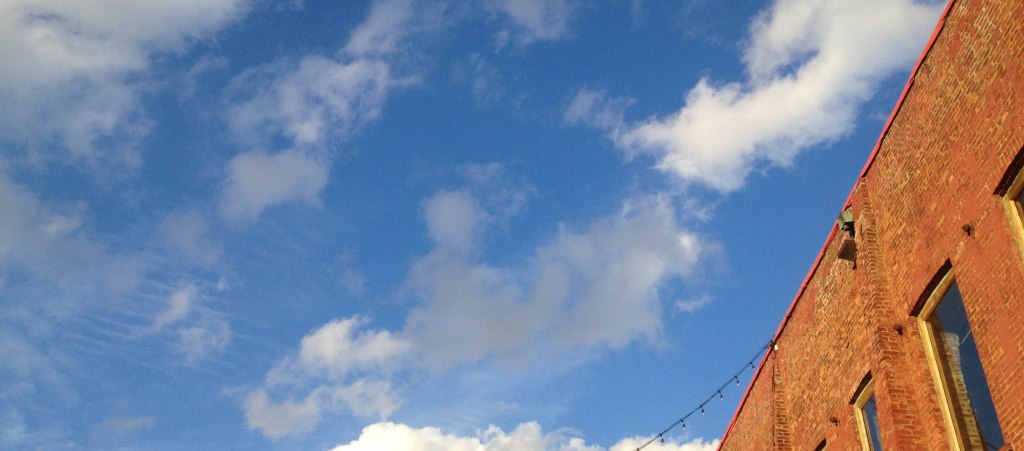
    Consider the sky above this amazing and crazy city of ours. It may seem mundane, but I ask you to find, spot, and watch clouds today. In fact, please look for clouds as often as you can over the next 24 hours. Today’s experiment is to take note of the ephemeral and to pay attention to what is passing over our heads.

    Spend One Day with Your Head in the Clouds

    You can take one 5-minute cloud break or make multiple 30-second sky scans. Find moments to pause in your daily routine:

    • Search the sky while drinking your morning coffee
    • Go outside for a lunch break and look up at the sliver of sky between skyscrapers
    • Look out to the horizon when the subway goes above ground
    • Find a piece of sky at sunset
    • Notice the night sky while walking home

    You do not need to know the name of the types of cloud you see. Describe to yourself what you see; the number, shape, color. If it helps you focus, take pictures of the clouds or make a few quick sketches.

    2016-04-26 09.43.48
    From “Keeping a Nature Journal” by Clare Walker Leslie & Charles E. Roth

    I discovered the idea of cloud collecting from The Cloud Collector’s Handbook by Gavin Pretor-Pinney (Found on Amazon). Not only is The Cloud Collector’s Handbook a wonderful resource for anyone who wants to be able to identify every cloud that floats by, it’s perfect for the competitive cloud-spotter as one can collect “points” for each cloud type. If you are curious about clouds, I recommend this charming book.

    Great Places in NYC to Collect Clouds

    If you want to fully embrace the cloud-spotting experience, lie on the ground in a park, swing in a hammock, or recline on a rooftop. Excellent locations for cloud-spotting:

    • Sheep Meadow, Central Park
    • Long Meadow, Prospect Park
    • Staten Island Ferry ride
    • Hammock Grove, Governors Island
    • Your favorite elevated subway stop or bridge crossing (My favorite is to look for clouds on the Q train while crossing the Manhattan Bridge.)

    “The sky is the daily bread of the eyes.” – Ralph Waldo Emerson

    When was the last time you really looked at the clouds? Today is the day, my friends. Let me know how it goes in the comments below.

  • Currently Reading: Field Guide to the Street Trees of New York City

    New York is one of the greatest cities of the world. It is also an urban forest with more than 5 million trees. These trees are not only in our parks. Nearly 600,000 trees line our streets, offering us shade, cooling our neighborhoods, diverting rain water, and cleaning our air. But if you haven’t paid much attention to your street trees, you’re not alone. The Field Guide to the Street Trees of New York City (public library) is a good place to start.

    2016-05-12 12.43.24

    The naturalist Leslie Day and illustrator Trudy Smoke have created a wonderful introduction to the urban forest outside your window. Their Field Guide to the Street Trees of New York City identifies the fifty most common tree species that exist in New York City, maps some of the city’s great trees, and provides steps for caring for and protecting street trees.

    Exploring Leafy Neighborhoods and Meeting “Tree People”

    The guide begins by profiling several New York neighborhoods across the boroughs: City Island in the Bronx, Brooklyn Heights in Brooklyn, Hamilton Heights and the Upper West Side in Manhattan, Astoria in Queens, and Tompkinsville in Staten Island. Day interviews local residents responsible for the introduction of street trees to their neighborhoods. She learns how these volunteers were inspired to plant the trees and how they continue to care for them.

    Day also presents a series of interviews of professional “tree people” who work for the city parks, botanical gardens, and urban arbor organizations for an insider view of the myriad of tree efforts in NYC.

    Identifying the Trees You See

    The m2016-05-13 11.45.43ajority of the book is dedicated to teaching you the basics of tree identification.
    It starts
    with an illustrated glossary and introduction to tree terminology. The guide features fifty of the most common species of NYC street trees, including the Tree of Heaven, London Plane, Callery Pear, elms, lindens, magnolias, maples, and oaks.

    For each tree species, there is an original drawing of leaves and photographs of bark, fruit, flower and twig. In addition to the descriptions of each species, Day offers the incredible useful bit of information –  specific addresses where you can see excellent examples of the trees.

    Trekking into the Urban Forest

    If you are just starting out, I encourage you to meet your closest tree. If you want to learn to recognize the street trees that grow near where you live and work, be inspired to explore other neighborhoods to see “famous trees,” and to learn how to care for street trees yourself, the Field Guide to the Street Trees of New York City is an excellent resource. Though the book may be a bit heavy for everyday meandering, it is a great reference guide and starting point for New Yorkers.

  • Meet Your Closest Tree

    As a New Yorker, I imagine you could easily list the best things within a few blocks your home: the closest deli, Thai restaurant, drop-off laundry location, bar, and the best subway car for your preferred exit.

    But here’s a question that may stump you. Can you tell me about your closest tree?

    Take a Good Long Look

    Today I invite you to take a careful, considered look at the tree nearest to your home. If, like me, you could easily list the best neighborhood places to eat, drink, and shop, but drew a blank when thinking of your closest tree, this could prove to be a worthwhile experiment.

    Even if you are one of the lucky ones with vast arboreal knowledge, I ask that you also play along. You may see something new or unexpected.

    The First Meeting

    I invite you walk to up to your closest tree and spend at least five minutes examining it. Imagine you must describe the tree to a sketch artist. What would you say?

    Here are a few questions to ask yourself:

    • How tall is it?
    • What sort of shape does it make overall?
    • If you had to hazard a guess, does it look like a younger or older tree?
    • What are the shapes of the branches? Wide? Low? Crooked? Spindly?
    • How would you describe the bark? Smooth, speckled, furrowed?
    • If there are leaves, what are the shapes of the leaves? What color? Do the leaves grow opposite of each other or do they alternate?
    • Is there fruit on the tree? Have blossoms or nuts fallen from it?
    • Do you think anything lives in it?
    • Do you know the type of tree it is? If not, are you curious?


    Notice Your Neighbor in the Future

    When you really look at the tree it may feel like meeting a neighbor for the first time:  you are not sure how the interaction will go, you may feel a little awkward, but afterwards, it’s easier to say hello. Now that you’ve “met” the tree, you may find it easier to notice it in the future. You may take note if its branches are bare in winter, its first buds and leaves in spring, and the color of its leaves in fall. This neighbor tree offers you a daily opportunity to notice change.

    If you know the species of your neighbor tree, that’s great. But – this is important – you don’t have to know the name of something to really notice it. If your curiosity is piqued and you want to identify the tree, learn more with Leslie Day’s helpful guide to the street trees of New York City.

    Places in NYC to Notice Trees

    I recommend you start with the closest tree to your apartment. If you want to expand the experiment, here are a few of my favorite places to notice and compare trees:

    Want to learn more about estimated 5.2 million trees in NYC? Check out the efforts by Million Trees NYC or help map the street trees at Trees Count.

    Please let me know how your meeting goes in the comments below. I’m curious.